
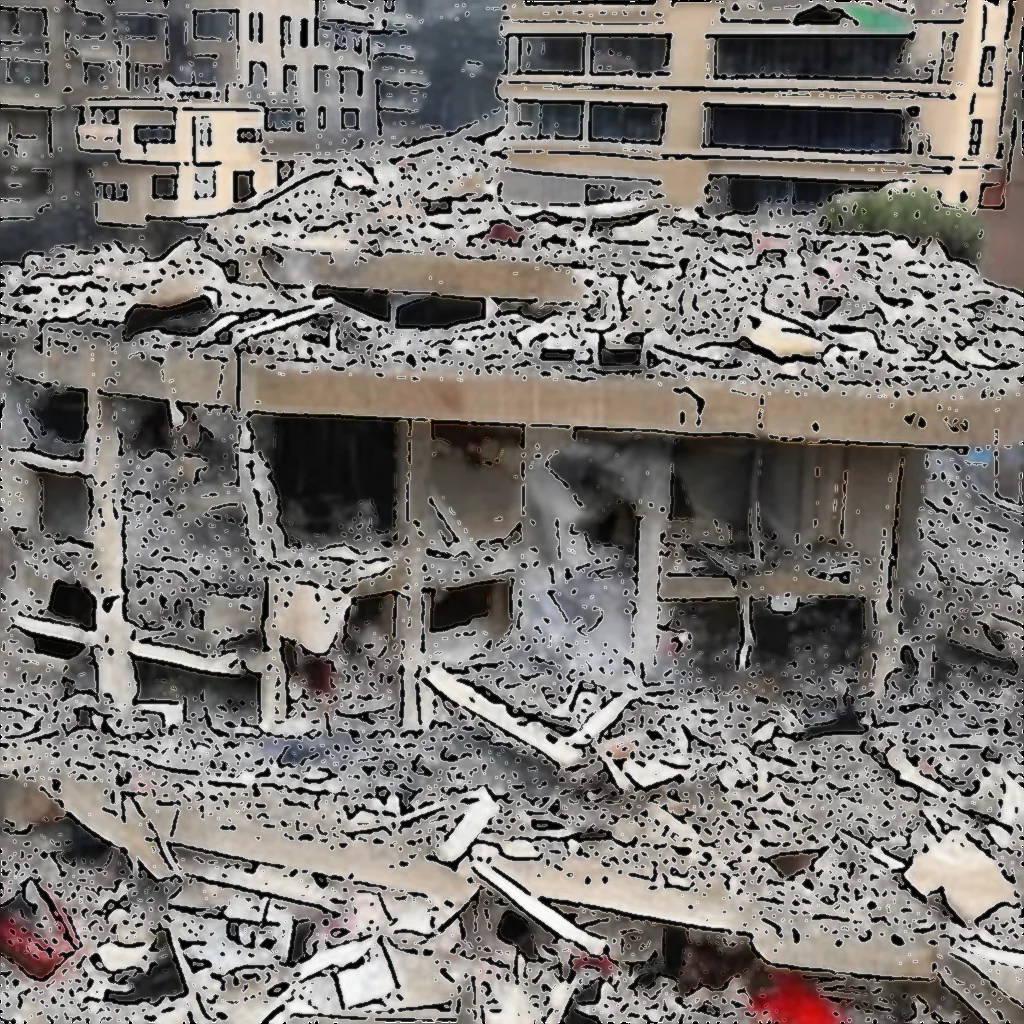
The explosion was caused by a large quantity of ammonium nitrate, a chemical compound used in fertilizers and explosives. The compound was stored improperly in a warehouse in Beirut’s port, leading to a catastrophic chain reaction. The incident has sparked widespread condemnation and calls for accountability. The Lebanese government has been criticized for its negligence in handling the blast, with many blaming the government for the tragedy. The explosion has also had a significant impact on the already fragile Lebanese economy.
More than a dozen others were wounded in Syria, according to the UK-based Syrian Observatory for Human Rights. “Fourteen people whose nationalities are unknown have been wounded in Damascus and its countryside after pagers used by Hezbollah exploded,” the organization said. Lebanon’s Foreign Ministry condemned what it described as a “dangerous and deliberate Israeli escalation.” Israel did not immediately comment on the incident. The Foreign Ministry accused Israel of threatening to “expand the war towards Lebanon on a large scale.” Hezbollah vows ‘just punishment’ for explosions Iranian-backed Hezbollah also blamed Israel for the explosions. “We hold the Israeli enemy fully responsible for this criminal aggression,” Hezbollah said.
It added that Israel “will certainly receive its just punishment for this sinful aggression.” A Hezbollah official, speaking on the condition of anonymity, told the Reuters news agency that the incident was “the biggest security breach” the group had been subjected to in nearly a year of conflict with Israel. Exploding pagers ‘unlikely to be an accident’ To view this video please enable JavaScript, and consider upgrading to a web browser that supports HTML5 video Reports that Israel targeted the communications devices and was behind the detonations remain unconfirmed. There have been near-daily cross-border exchanges between Israel and Hezbollah fighters since Hamas attacked southern Israel on October 7, triggering war in the Gaza Strip.
What we know about the incident A Hezbollah official, speaking to Associated Press on condition of anonymity because he was not authorized to speak to the media, said the explosions were the result of “a security operation that targeted the devices.” “The enemy [Israel] stands behind this security incident,” the official said, without elaborating. He added that the new pagers that Hezbollah members were carrying had lithium batteries that apparently exploded. According to the German DPA news agency, the Bahman hospital in Beirut received more than 100 people. Some were said to be in critical condition. The explosions detonated in a number of towns in Lebanon Image: AFP
The Lebanese Health Ministry urged all hospitals across the country to be on alert. It also advised people to stay clear of devices that might pose a threat. **Detailed Text:**
In the wake of recent events, the Lebanese Health Ministry has issued a stern warning to all hospitals across the nation.
Why is Hezbollah using pagers? A pager is a wireless telecommunications device that receives and displays messages. It was among the first compact mobile communication devices to reach the mass market, and although smartphones have largely supplanted it, some people still use this technology today. The pagers use their own frequency and are therefore considered more reliable because they bypass cellular networks, which can experience interruptions, connection problems or interception of communications. Makram Rabah, a lecturer in the history department at the American University of Beirut, told DW that he believes Hezbollah has purchased a large number of pagers because its landline network and even mobile phone operators have recently been hacked by Israel, which has driven them to a more low-tech fashion.
The explosions were not random. They were carefully planned and executed, indicating a high level of sophistication and organization. The timing of the explosions was also carefully chosen, occurring during a period of heightened tension between Israel and Hezbollah. The attack, which targeted a Hezbollah stronghold, was a calculated move to inflict maximum damage and psychological impact.
The blasts came after weeks of private diplomacy by the US to prevent an Iranian retaliation against the killing of Hamas political chief Ismail Haniyeh in Tehran in July, which Iran blames on Israel. “We would urge Iran not to take advantage of any incident to try to add further instability and to further increase tensions in the region,” Miller told reporters. United Nations spokesperson Stephane Dujarric said the developments in Lebanon were concerning, especially given the “extremely volatile” context.” “I think we cannot under underscore enough the risks of escalation in Lebanon and in the region,” Dujarric added. The United States said it is gathering information about the incident Image: ANWAR AMRO/AFP
* **Hamas vs.
* Hamas, a militant group, is fighting Israel in the Gaza Strip. * Hamas has international backing from Hezbollah. * Hamas blames Israel for the explosions. * Israel is fighting Hamas in the Gaza Strip. * The explosions are a result of a conflict between Israel and Hamas.