
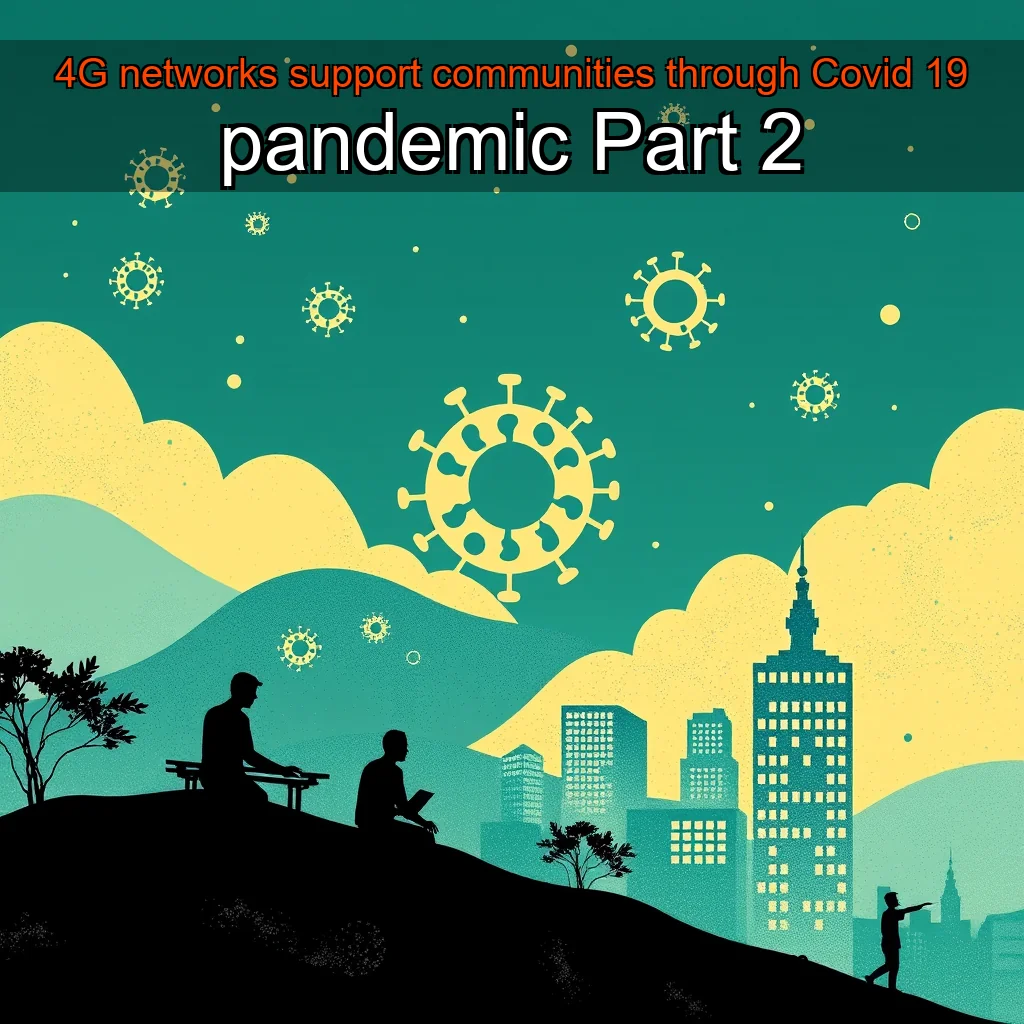
4G networks support communities through Covid 19 pandemic Part 2

Artistic representation for 4G networks support communities through Covid 19 pandemic Part 2

5G is a new wireless technology that promises to revolutionize the way we communicate and access information. It offers faster data speeds, lower latency, and greater connectivity than its predecessors.

The Benefits of 5G

The benefits of 5G are numerous and far-reaching. Some of the key advantages include:

  • Faster data speeds: 5G offers data speeds that are significantly faster than those of 4G. This means that users can enjoy seamless video streaming, online gaming, and other data-intensive activities without any lag or buffering. Lower latency: 5G reduces latency to as low as 1 millisecond, which is much faster than the 20-50 milliseconds of 4G. This means that users can enjoy real-time communication, online gaming, and other applications that require fast response times. Greater connectivity: 5G provides greater connectivity than 4G, allowing users to connect to the internet from anywhere, at any time. This means that users can stay connected to their loved ones, access important information, and enjoy a range of other benefits without any limitations. ## The Impact of 5G on Society*
  • The Impact of 5G on Society

    The impact of 5G on society is significant and far-reaching. Some of the key effects include:

  • Improved healthcare: 5G enables remote healthcare services, allowing patients to receive medical treatment remotely. This can help reduce the burden on hospitals and healthcare systems, and improve patient outcomes. Enhanced education: 5G enables remote learning, allowing students to access educational resources and participate in online classes from anywhere. This can help improve educational outcomes and increase access to education for disadvantaged groups. Increased economic growth: 5G can help drive economic growth by enabling businesses to operate more efficiently and effectively.

    The Importance of LTE (4G) Mobile Broadband

    LTE (Long-Term Evolution) or 4G mobile broadband is a crucial technology for bridging the digital divide. It offers faster data speeds, lower latency, and greater connectivity than its predecessors, making it an essential tool for accessing the internet, online services, and digital opportunities.

    Key Features of LTE (4G) Mobile Broadband

  • Faster Data Speeds: LTE (4G) provides data speeds of up to 100 Mbps, making it ideal for streaming, online gaming, and other bandwidth-intensive activities. Lower Latency: LTE (4G) reduces latency to as low as 1 ms, enabling real-time communication, online collaboration, and seamless video conferencing. Greater Connectivity: LTE (4G) offers widespread coverage, making it accessible to a larger population, including rural and underserved areas. ## The Impact of LTE (4G) on Poverty Reduction**
  • The Impact of LTE (4G) on Poverty Reduction

    Expanding LTE (4G) mobile broadband coverage and adoption can have a significant impact on poverty reduction. By providing access to the internet, online services, and digital opportunities, LTE (4G) can:

  • Enhance Economic Opportunities: LTE (4G) can enable people to access online job platforms, e-commerce, and digital marketplaces, creating new economic opportunities and improving livelihoods.

    The remaining 10% of the world’s population has limited or no mobile coverage.

    The State of Mobile Coverage

    The GSMA’s latest report highlights the significant progress made in expanding mobile coverage globally. According to the report, 80% of the world’s population now has access to mobile networks, up from 50% in 2010.

    However, the region is expected to see a significant increase in mobile broadband penetration over the next five years, reaching 43% by 2025.

    The Rise of Mobile Broadband in Africa

    A Growing Market

    Africa is poised to become the fastest-growing global region for mobile broadband, with the GSMA predicting a significant increase in mobile broadband penetration over the next five years. The region currently has a relatively low mobile broadband subscriber base, with 239 million subscribers and a penetration rate of just 23%.

    Seamless handovers between 4G and 5G networks ensure uninterrupted service for users.

    This allows for seamless handovers between the two networks, ensuring that users can maintain uninterrupted service even when switching between the two technologies.

    The Benefits of ENDC

    ENDC enables network operators to take advantage of the strengths of both 4G and 5G networks. By using both schedulers, operators can provide users with a more robust and reliable service.

    Investing in 4G for a Secure Future Growth.

    The Benefits of Investing in 4G

    Investing in 4G networks can provide numerous benefits for national networks, including:

  • Enhanced capacity and coverage
  • Improved network reliability and quality
  • Increased data speeds
  • Better support for IoT and M2M applications
  • Enhanced security features
  • The Role of 4G in Securing Future Growth

    As 5G networks become increasingly widespread, it is essential for national networks to invest in 4G to ensure a smooth transition and secure future growth opportunities. Here are some reasons why:

  • Future-proofing: 4G networks can provide a solid foundation for 5G networks, allowing for seamless handovers and minimizing disruptions to users.

    The 4G Era: A Foundation for 5G

    The transition to 4G has been a significant milestone in the history of telecommunications. It marked a major shift from the 2G era, which was characterized by slow data speeds and limited functionality. The 4G era, on the other hand, brought about faster data speeds, improved coverage, and enhanced mobile broadband capabilities.

    Key Features of 4G

  • Faster Data Speeds: 4G networks offer significantly faster data speeds compared to 2G and 3G networks. This is achieved through the use of advanced technologies such as orthogonal frequency-division multiple access (OFDMA) and multiple-input multiple-output (MIMO) techniques. Improved Coverage: 4G networks provide better coverage and penetration, allowing users to access high-speed internet and mobile services from a wider range of locations. Enhanced Mobile Broadband: 4G networks enable the delivery of high-definition video, online gaming, and other bandwidth-intensive applications. ### The Regulatory Landscape**
  • The Regulatory Landscape

    From a policy perspective, the transition to 4G has been shaped by regulatory frameworks and policies.

    news

    news is a contributor at OpenLTE. We are committed to providing well-researched, accurate, and valuable content to our readers.
    You May Also Like

    Artistic representation for Private lte / 5g market to hit $8 . 9 billion by 2029 , says berg insight the private lte / 5g market is projected to reach $8.9 billion by 2029, driven by a growing demand for connectivity solutions in industries such as manufacturing, transportation, and utilities.

    Private lte / 5g market to hit $8 . 9 billion by 2029 , says berg insight the private lte / 5g market is projected to reach $8.9 billion by 2029, driven by a growing demand for connectivity solutions in industries such as manufacturing, transportation, and utilities.

    Private LTE/5G networks are becoming increasingly popular as companies seek more secure and reliable connectivity solutions. Dedicated spectrum is a...

    Artistic representation for Lebanon : 8 killed , thousands injured in pager explosion – DW – 09 / 17 / 2024 Let me know what your title would be.

    Lebanon : 8 killed , thousands injured in pager explosion – DW – 09 / 17 / 2024 Let me know what your title would be.

    The explosion was caused by a large quantity of ammonium nitrate, a chemical compound used in fertilizers and explosives. The...

    Artistic representation for Wireless Technology and Vehicle Safety

    Wireless Technology and Vehicle Safety

    This vision was based on the idea that 5G would be the key to unlocking the potential of the Internet...

    Artistic representation for How to Check Your Cellular Network Coverage

    How to Check Your Cellular Network Coverage

    Coverage Maps: A Crucial Tool for Cellular Network SelectionWhen choosing a cellular carrier, one of the most critical factors to...

    About news

    Expert in writing with years of experience helping people achieve their goals.

    View all posts by news β†’

    Leave a Reply

    About | Contact | Privacy Policy | Terms of Service | Disclaimer | Cookie Policy
    © 2026 OpenLTE. All rights reserved.